Introduction
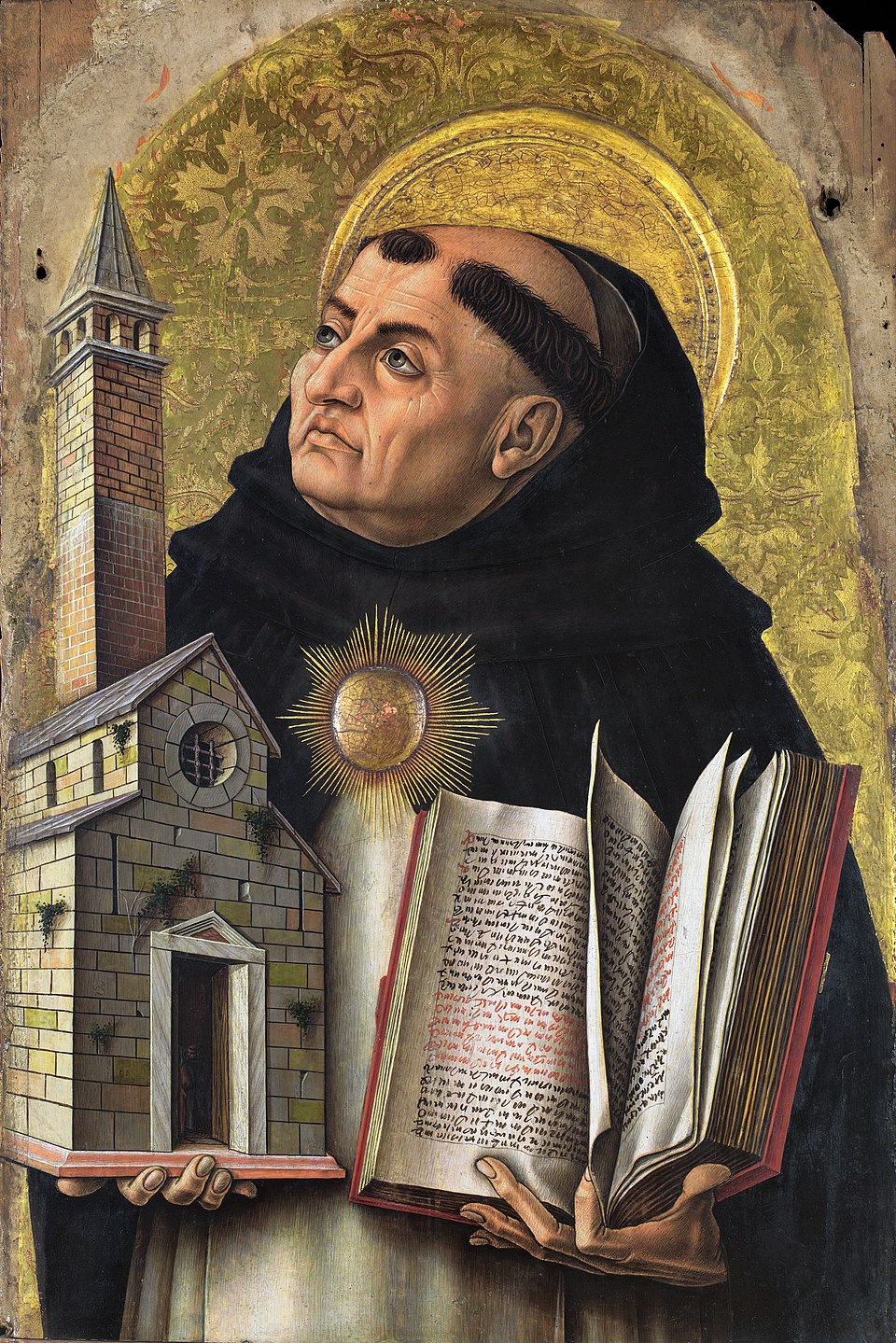
Thomas Aquinas is known as the “Angelic Doctor” of the Church, renowned as the man who rediscovered Aristotle for Western civilization. Throughout his life, he lectured in Paris, Naples, Cologne, and Rome, shaping theological and philosophical thought profoundly.
Early Life
Thomas Aquinas was born around 1225 in the family castle of Roccasecca near Aquino, located in the Kingdom of Sicily, now present-day Lazio, Italy. He was born into the powerful Aquino family. His father, Landulf VI of Aquino, was a knight in the service of Frederick II, Holy Roman Emperor, while his mother, Theodora Galluccio, was a countess from the prestigious Neapolitan Caracciolo family.
Thomas was the youngest of four sons and had two sisters. Unlike his brothers, who pursued military careers, Thomas was intended by his family to follow his uncle, Sinibald, abbot of Monte Cassino, into a religious career with the Benedictines, a common path for younger noble sons at the time.
At age of five, Thomas began his education at previously mentioned Monte Cassino monastery.
After conflicts in 1239, Thomas moved to Naples, where Emperor Frederick II had established a university. There he learned arithmetic, geometry, astronomy, music, grammar, and logic. This university was also where he was first introduced to Aristotelian philosophy.
Joining the Dominicans
When he was nineteen, Thomas decided to join the Dominican Order because he admired their commitment to simple living, preaching, and deep study. His family strongly opposed this choice, wanting him to become the abbot at Monte Cassino for their family’s prestige. They imprisoned him for nearly a year to change his mind.
At one point, Thomas’s brothers even sent a prostitute to tempt him, hoping to break his vow of celibacy and turn him away from his religious life. According to official canonization records, Thomas chased her off with a burning log, drew a cross on the wall, and fell into a mystical ecstasy experiencing a spiritual vision confirming his choice of lifelong chastity.
Eventually, recognizing his determination, his mother arranged a discreet escape to save the family’s dignity, allowing Thomas to finally join the Dominicans.
Benedictines vs. Dominicans
Thomas’s family preferred the Benedictines because of their wealth and influence. In contrast, the Dominicans lived simple lives devoted to preaching and studying, which his family thought was unsuitable for someone of noble birth.
Later Life and Death
In his later years, Thomas Aquinas continued to teach and write across major intellectual centers of Europe, including Paris, Naples, and Rome. As was typical for medieval scholars, especially those in religious orders, he did not remain in one place for long. Professors in the Middle Ages—unlike today—were clerics, often friars or priests, who moved between universities and monastic schools as part of their religious mission. Latin, the universal language of scholarship at the time, allowed thinkers like Aquinas to engage in dialogue across regions and institutions.
In 1274, Pope Gregory X summoned Aquinas to attend the Second Council of Lyon. The purpose of the council was to attempt a reconciliation between the Roman Catholic and Eastern Orthodox Churches, divided since the Great Schism of 1054. Aquinas was to contribute his theological expertise, especially through a work he had written at the request of Pope Urban IV titled Contra errores graecorum, which addressed differences between Latin and Greek theology.
While traveling to the council along the Appian Way, Aquinas struck his head on a tree branch and soon fell gravely ill. He was taken to the Cistercian abbey of Fossanova to recover, but his condition worsened. There, the monks cared for him during his final days. As he lay dying, Aquinas reportedly received the last rites and offered a final act of devotion, stating, “I have written and taught much about this very holy Body, and about the other sacraments in the faith of Christ, and about the Holy Roman Church, to whose correction I expose and submit everything I have written.” He died on 7 March 1274, engaged in scriptural reflection, likely on the Song of Songs, his last known commentary.
Scholastic Philosophy
Scholasticism was a system of theology and philosophy developed and taught in medieval European universities. It was based on Aristotelian logic and the writings of the early Christian Fathers. Scholastic thinkers focused on documenting, analyzing, and refining arguments, applying reason not only to philosophy and theology, but also to natural science, legal studies, and ethics.
The 13th century marked the peak of scholasticism, often called the age of High Scholasticism. During this time, Christian thinkers faced intellectual challenges from both developed Judaism and the Islamic world, which had rediscovered and expanded Aristotelian philosophy. Through Muslim scholars like Averroes, a 12th-century polymath and jurist, the works of Aristotle were transmitted back to the West. This made it possible for later scholastics, especially Thomas Aquinas, to integrate Aristotle’s thought into Christian theology.
His Philosophy
Thomas Aquinas’s philosophy represents a comprehensive synthesis of Christian theology with Aristotelian philosophy, adapted to explain and defend Catholic doctrine. This integration is a cornerstone of Scholasticism.
Central to Aquinas’s thought is the harmonization of faith and reason. He viewed theology as a science—not in the empirical sense, but as a disciplined field of knowledge grounded in divine revelation as transmitted through scripture and Church tradition. For Aquinas, faith and reason are distinct yet complementary tools: both are necessary for attaining a true understanding of God.
Aquinas emphasized that God can be known through nature—a view that supports the idea of Natural Law. He argued that rational inquiry and the observation of the natural world are valid paths to divine knowledge, since creation reflects the Creator. This perspective is encapsulated in his famous principle: “gratia non tollit naturam, sed perficit”(“grace does not destroy nature, but perfects it”).
Although he engaged deeply with philosophical issues, Aquinas never identified himself primarily as a philosopher. He was critical of pagan philosophers for lacking the fullness of Christian truth, yet he deeply respected Aristotle—so much so that he referred to him simply as “the Philosopher” in his Summa Theologiae. Importantly, Aquinas did not conform Christian doctrine to Aristotelianism; rather, he adapted Aristotelian ideas where compatible and corrected them where they conflicted with Christian belief.
Aquinas’s philosophical contributions have had a profound and lasting influence on Christian theology, particularly within the Catholic tradition, and on Western philosophical thought as a whole.
Major Works
Thomas Aquinas wrote across a wide range of disciplines, including theology, philosophy, law, and biblical commentary. His most famous work, Summa Theologiae, is a comprehensive guide to Christian doctrine, divided into parts dealing with God, moral life, and Christ’s work. He also wrote Summa Contra Gentiles, a philosophical defense of Christianity aimed at non-believers. In De Ente et Essentia, he explored the distinction between essence and existence, laying the foundation for his metaphysical thinking. His Treatise on Law outlines four kinds of law—eternal, natural, human, and divine—and remains central to discussions on natural law theory and justice. He also commented on many books of the Bible, such as the Psalms and Pauline letters, and wrote detailed commentaries on Aristotle’s works to reconcile classical philosophy with Christian theology.
Five ways to proof Gods existence
Thomas Aquinas famously formulated five logical arguments for the existence of God, commonly known as the “Five Ways.” These arguments reflect his methodical style of reasoning and deep engagement with Aristotelian philosophy. In this blog post, we will focus on just one of them—the Third Way, based on possibility and necessity—to get a sense of his approach without going into excessive length.
The Third Way: Possibility and Necessity
The third way is taken from possibility and necessity, and runs thus. We find in nature things that are possible to be and not to be, since they are found to be generated, and to corrupt, and consequently, they are possible to be and not to be. But it is impossible for these always to exist, for that which is possible not to be at some time is not. Therefore, if everything is possible not to be, then at one time there could have been nothing in existence. Now if this were true, even now there would be nothing in existence, because that which does not exist only begins to exist by something already existing. Therefore, if at one time nothing was in existence, it would have been impossible for anything to have begun to exist; and thus even now nothing would be in existence–which is absurd. Therefore, not all beings are merely possible, but there must exist something the existence of which is necessary. But every necessary thing either has its necessity caused by another, or not. Now it is impossible to go on to infinity in necessary things which have their necessity caused by another, as has been already proved in regard to efficient causes. Therefore we cannot but postulate the existence of some being having of itself its own necessity, and not receiving it from another, but rather causing in others their necessity. This all men speak of as God.
— Thomas Aquinas, Summa Theologica, Complete & Unabridged, trans. Fathers of the English Dominican Province (Function Books, Kindle Edition), pp. 53–54.
Legacy
Thomas Aquinas’s legacy profoundly impacts theology, philosophy, education, and law. He is central to Catholic theology. As the founder of Thomism, he is renowned for his synthesis of faith and reason. His philosophical contributions on natural law, ethics, and metaphysics have been highly influential. The Scholastic method he employed has shaped educational practices extensively. Aquinas was canonized in 1323 and declared a Doctor of the Church in 1567, and he is revered as the “Angelic Doctor.” Thomas Aquinas remains a pivotal figure in the Western intellectual tradition, continuously shaping theological, philosophical, and ethical discourse.
Summa Theologica
The most prominent book of Thomas Aquinas is the Summa Theologica. You can buy the book using my link—either in ebook format (which is really cheap, only $1), or as a paperback if you want it for your home library. Buying through my link would create opportunities for me to create new and better content.
Resources
Stanford Encyclopedia of Philosophy. “Thomas Aquinas.” https://plato.stanford.edu/entries/aquinas/
Wikipedia. “Thomas Aquinas.” https://en.wikipedia.org/wiki/Thomas_Aquinas
Britannica. “Saint Thomas Aquinas.” https://www.britannica.com/biography/Saint-Thomas-Aquinas
Wikipedia. “Dominican Order.” https://en.wikipedia.org/wiki/Dominican_Order
YouTube. “Thomas Aquinas Documentary.” https://www.youtube.com/watch?v=J0Blh1all3U&t=1201s
Wikipedia. “Averroes.” https://en.wikipedia.org/wiki/Averroes
YouTube. “Aquinas: A Short Introduction.” https://www.youtube.com/watch?v=lwN1-5kZOOs
Wallis, Charles. “Aquinas.” California State University, Long Beach. https://home.csulb.edu/~cwallis/100/aquinas.html
Aquinas, Thomas. Summa Theologica, Part I (“Prima Pars”). Translated by the Fathers of the English Dominican Province. Electronically developed by Coyote Canyon Press.
No responses yet