Disclaimer
In this series of articles, I’ll try to go through the history of Western philosophy. This isn’t some deep dive into philosophy. I’m just starting to get interested in it, and this is an introduction to philosophy — for me as much as for you. I’ve tried to give the history of philosophy some structure here. It’s meant more as an introduction to individual movements, from which you or I can jump off and go deeper into whatever interests us. In the future, I might go more in depth on some of the topics that catch my attention, and build up more knowledge for both of us. Enjoy! 🙂
Introduction
We should begin with the Presocratics, as most philosophy courses do. ‘Presocratics’ is a very broad term, which covers many schools and philosophers. Today we’ll start with the Milesian School.
The Milesian School was founded in the 6th century BC. It was led by Thales, Anaximander, and Anaximenes from the town of Miletus (hence the name of the school). This school of thought marked the beginning of Western philosophy. They were looking for natural explanations for the world around them, moving away from mythological accounts. They introduced the concept of arche — the fundamental substance of the universe.
These early Greek thinkers also made real contributions to fields like geometry, astronomy, and geography. Their ideas about the arche — water, apeiron, and air — laid the groundwork for rational inquiry and scientific thinking, and went on to influence later philosophers and scientists.
Thales (626/623 – 548/545 BC)
Thales proposed water as the fundamental substance — the arche — from which everything in the universe originates. Water here isn’t meant literally. The idea is more that it’s a kind of first cause, an arche, something elusive that underlies everything.
He also developed a theory that the Earth floated on a vast ocean of water. Beyond philosophy, he made notable contributions to geometry (Thales’ Theorem) and astronomy — he predicted a solar eclipse in 585 BCE, which was the thing that really made him famous. People were genuinely surprised by it.
Anaximander (610 – 546 BC)
Anaximander was a student and successor of Thales. He took his teacher’s idea and developed it further, introducing the concept of the apeiron — the boundless, indefinite substance — as the arche. Rather than picking something concrete like water, he argued the original principle had to be something unlimited and undefined.
He also created the first known map of the world, which was a significant step forward in geography.
Anaximenes (586/585 – 526/525 BC)
Anaximenes was a student of Anaximander. He identified air as the primary substance of the universe. He explained natural phenomena — like the formation of clouds and rain — through the processes of rarefaction (thinning) and condensation (thickening) of air.
Sources
Kenny, A. An Illustrated Brief History of Western Philosophy (20th Anniversary Edition). Wiley-Blackwell.
Russell, B. The History of Western Philosophy. Simon & Schuster.
История западной философии. Часть 1. Античность. Средневековье. Возрождение [History of Western Philosophy. Part 1. Antiquity. Middle Ages. Renaissance.]
Wikipedia. History of Philosophy. https://en.wikipedia.org/wiki/History_of_philosophy
Fiveable. Milesian School: Thales, Anaximander, Anaximenes. https://fiveable.me/history-ancient-philosophy/unit-1/milesian-school-thales-anaximander-anaximenes/study-guide/b4IOJ6EH2hjg2CcW
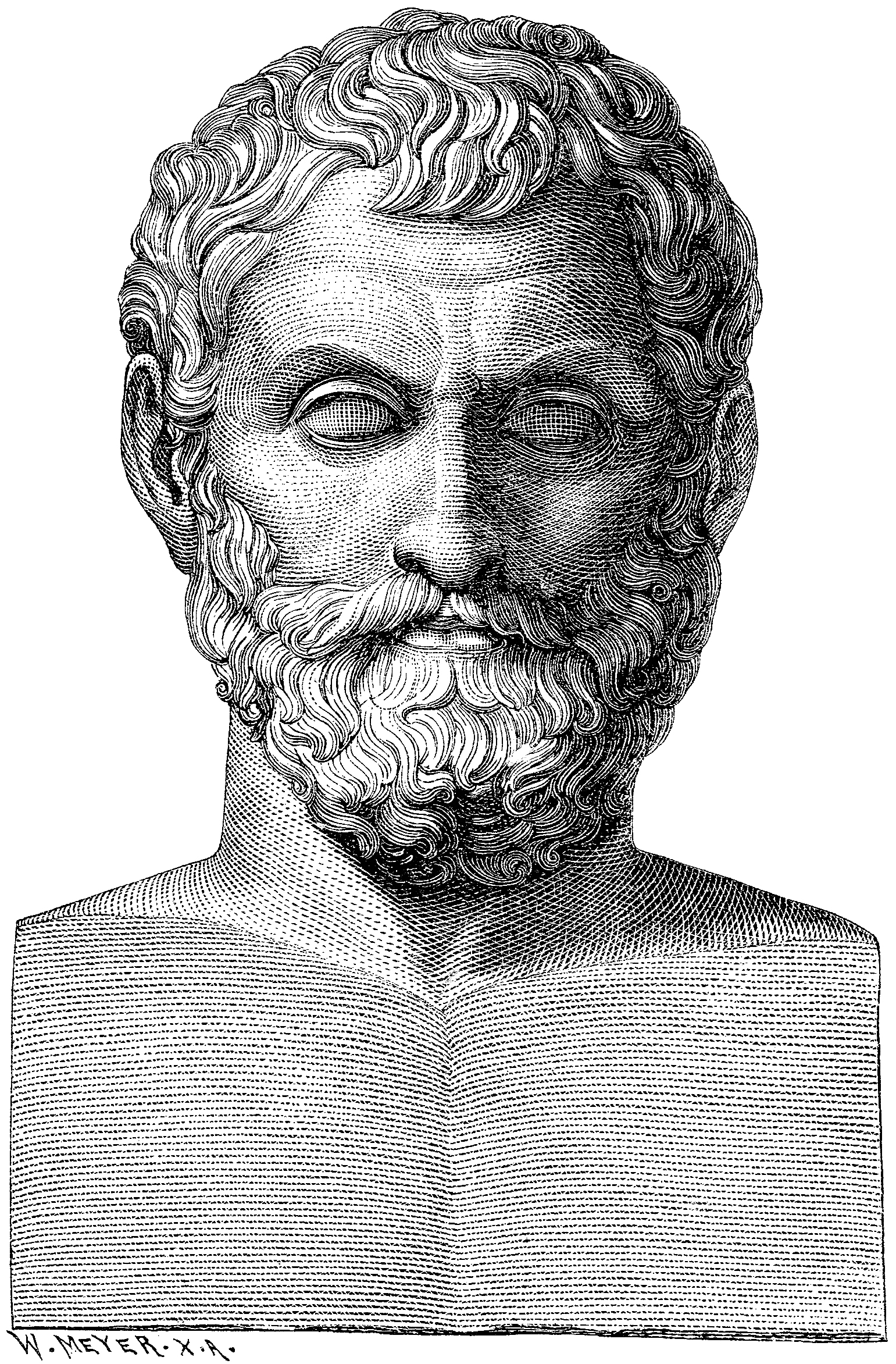
Featured image: Posthumous portrait of Thales by Wilhelm Meyer, based on a bust from the 4th century; Wilhelm Meyer, Public domain, via Wikimedia Commons

No responses yet