These days I see a lot of fascination with the great general Belisarius by guys on the internet. I often see Byzantine edits with the famous epic “Belisarius song” played in the background. But who was this general? And how did he become so significant that people admire his genius and aura even almost 1500 years after his death? Let’s look at this persona together in this article.
Where he came from
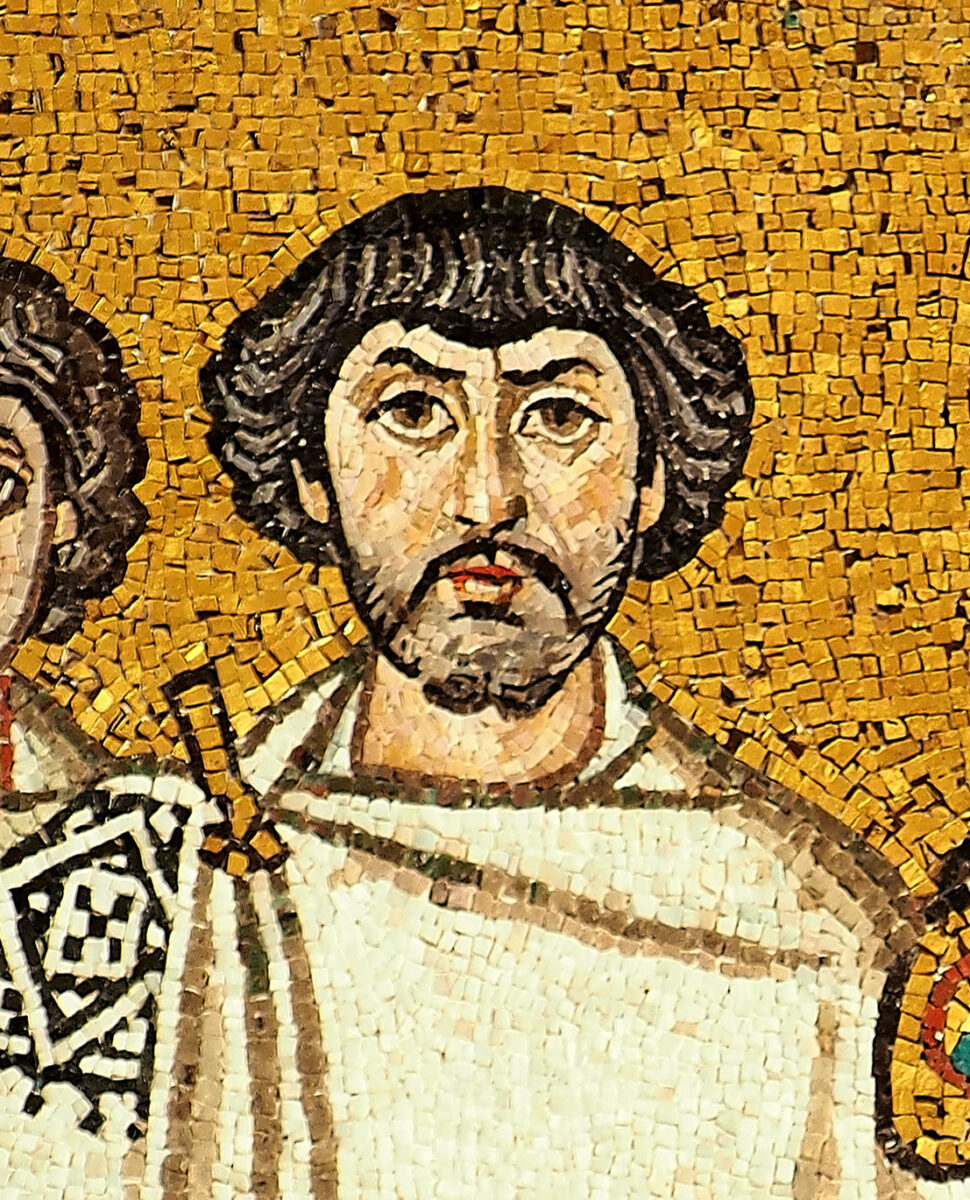
Flavius Belisarius was born around 505 CE in Illyria, which is the western part of the Balkan Peninsula. He was born of peasant stock and rose to become one of the greatest generals, if not the greatest, of the Byzantine Empire. He was a Roman, not a Slav, carrying on that old Roman military tradition. If you want to know what he looked like, the Justinian Mosaic panel in the Basilica of St. Vitale (above) shows us – an oval face, large brown eyes, long nose, the kind of look you see in Roman Greek art.
He served as commander of the military under Byzantine Emperor Justinian I, with whom he had a notoriously difficult relationship. By 526 he had become a senior-level guardsman of Justinian, who was the nephew of Emperor Justin I.
The Nika Riots
When Justin died in 527 and Justinian became emperor, he appointed Belisarius to command a Roman army in the east. But before his famous campaigns, something important happened back in Constantinople.
Justinian had been carrying out reforms and cracking down on the chariot racing factions. These factions, called demes, were a big deal in Byzantine society. They were basically a mix of street gangs and political groups who would shout demands at the emperor between races and sometimes backed rivals to the throne. When Justinian started limiting their power and executing rioters, things got out of hand fast.
The Nika riots of 532 lasted a whole week. Fires burned down nearly falf of the city including the original Hagia Sophia. (The Hagia Sophia you know today is not the original one. It is the one bulit by the emperor Justinian after the riots ended.) Belisarius dealt with it directly – he bypassed the door where the rebel leader Hypatius was hiding and charged straight into the crowd. His colleague Mundus joined in when he heard the fighting, while Narses blocked the exits to trap the rioters inside. The revolt ended in a massacre. Between 30,000 and 60,000 people died, most of them unarmed civilians.
His Tactical Genius
What really made Belissarius famous was how he fought – he was a master of military deception.
The Vandalic War – In 533, Justinian sent Belisarius to take back the North African provinces that were held by the Vandals. The victory was surprisingly fast and decisive, and it pushed Justinian to try and recover even more of the old western provinces.
Tricking the Persians – In 542, the Persian king Khosrow wanted to raid Byzantine territory again. Belisarius moved to the area and when Khosrow sent an ambassador to meet him, Belisarius showed up with 6,000 of his best soldiers – but they were carrying only hunting equipment. It looked like a casual hunting party from a much bigger force waiting somewhere nearby. Khosrow got the message and called off the invasion.
The Siege of Ariminum – The Goths had the city of Ariminum, modern day Rimini in Italy, under siege. Belisarius needed to break it but his force was too small to fight the Goths directly. So he approached the city from multiple directions at once, including from the sea, and ordered his troops to light more campfires than their numbers actually needed. The Goths thought they were completely surrounded by a massive army. They panicked and retreated all the way back to their capital at Ravenna. Belisarius walked into Ariminum without a single battle.
The Gothic War and Rome – During the Gothic War, Belisarius and his troops recaptured the city of Rome even though they were significantly outnumbered, and then held it during a siege against great odds. To take Rome he put the bulk of his army in front of the Aurelian walls to grab the defenders’ attention, while secretly sending a small group into the city through an aqueduct. Once inside they overcame the defenders and opened the gates. Just like in Africa, his good treatment of the locals paid off as people inside had pro-Roman sympathies and helped him.
His Last Battle
By 559 Belisarius was retired. These times 7,000 Kutrigur Bulgars (Huns) led by Khan Zabergan invaded and headed straight for Constantinople. Justinian had basically nothing to defend it with, so he called Belisarius back.
What Belisarius got to work with was not much – 300 heavily armed veterans from the Italian campaign and around 1,000 conscripted refugees fleeing from the Huns themselves. That was it, against 7,000 Huns.
He camped close to the Huns and had the civilians dig a trench for protection. He lit many torches to make his camp look bigger than it was. Then he found a narrow pass where the Huns wouldn’t be able to spread out and use their numbers or fire their bows properly. He put 100 veterans on each side and another 100 blocking the path directly ahead.
When 2,000 Huns attacked, Belisarius had his blocking force charge forward while the civilians made as much noise as possible from behind. The Huns got confused, then got pressed together so tightly they couldn’t even draw their bows. They fled in disorder and Belisarius chased them so hard they didn’t even manage to fire arrows during the retreat. The Huns crossed back over the Danube. Constantinople was safe. The city called him a hero again.
The End of His Life
In 562, Belisarius was put on trial in Constantinople, accused of conspiring against Justinian. He was found guilty and placed under house arrest. But not long after, Justinian pardoned him and restored him to favour at the imperial court. The famous story that he was blinded is just a legend – it didn’t happen.
In 565, both Belisarius and Justinian died within a few months of each other. Belisarius likely died at his estate of Rufinianae on the Asiatic side of Constantinople, possibly buried near one of the two churches in the area, perhaps Saints Peter and Paul.
Why Does He Still Matter?
Belisarius was instrumental in the reconquest of much of the Mediterranean territory belonging to the former Western Roman Empire, which had been lost less than a century prior. He conquered the Vandal Kingdom of North Africa in nine months and conquered much of Italy during the Gothic War. He is considered one of the greatest military commanders of Byzantium and in history generally. One of the defining features of his career was his success despite varying levels of available resources.

The map of the Roman Empire between the rise to power of Justinian in 527 and his and Belisarius’ death in 565 shows just how much territory was recovered. Their partnership increased the size of the empire by 45 percent. Belisarius contributed immensely to that expansion.
He is listed among the candidates for the title of “Last of the Romans” – meaning the last person who most perfectly embodies the values of the Roman Empire at its best.
Sources
-
- Cartwright, Mark. 2014. “Belisarius.” World History Encyclopedia. October 21, 2014. https://www.worldhistory.org/Belisarius/.
-
- Greek American Experience. 2018. “In the Footsteps of Byzantium: Belisarius, the Last of the Romans.” September 25, 2018. https://greekamericanexperience.wordpress.com/2018/09/25/in-the-footsteps-of-byzantium-belisarius-the-last-of-the-romans/.
-
- Wikipedia. n.d. “Belisarius.” Accessed [Insert Date]. https://en.wikipedia.org/wiki/Belisarius.
-
- Wikipedia. n.d. “Gothic War (535–554).” Accessed [Insert Date]. https://en.wikipedia.org/wiki/Gothic_War_(535–554).
-
- Wikipedia. n.d. “Kingdom of Iberia.” Accessed [Insert Date]. https://en.wikipedia.org/wiki/Kingdom_of_Iberia.
-
- Wikipedia. n.d. “Nika Riots.” Accessed [Insert Date]. https://en.wikipedia.org/wiki/Nika_riots.
-
- Wikipedia. n.d. “Rimini.” Accessed [Insert Date]. https://en.wikipedia.org/wiki/Rimini.
-
- Wikipedia. n.d. “Siege of Ariminum (538).” Accessed [Insert Date]. https://en.wikipedia.org/wiki/Siege_of_Ariminum_(538).
No responses yet